
Women’s empowerment & land rights in the agricultural sector in Benin
Résumé
Autonomisation et droits fonciers des femmes dans le secteur agricole au Bénin
Description du sujet. En Afrique subsaharienne, notamment au Bénin, l’autonomisation des femmes reste limitée à cause de l’incertitude concernant les facteurs clés comme l’accès sécurisé à la terre. Malgré des lois égalitaires, les coutumes et l’autonomie villageoise fragilisent leurs droits, entraînant des discriminations et des insécurités foncières persistantes, un problème encore peu étudié.
Objectifs. Cette étude vise à analyser si les droits fonciers (héritage, achat, donation) améliorent l’autonomie des femmes dans le secteur agricole au Bénin.
Méthode. L’analyse repose sur des données collectées en 2021 auprès de 2 819 ménages dont 899 représentés par des femmes, répartis dans 44 communes du Bénin. L’autonomisation des femmes est mesurée à l’aide de l’indice WEAI (Women’s Empowerment in Agriculture Index) et les déterminants par un modèle logit.
Résultats. Trois principaux résultats se dégagent de l’étude. Seulement 4,78 % des femmes rurales participent aux prises de décision au sein de leur ménage ; les femmes disposant d’une pleine propriété foncière (acquise par achat, don ou héritage) présentent des niveaux plus élevés d’autonomisation ; les revenus issus de la propriété foncière renforcent la sécurité foncière et ont un effet positif sur le pouvoir décisionnel des femmes.
Conclusions. Ces résultats suggèrent que des politiques foncières inclusives renforçant la sécurité foncière sont essentielles non seulement pour accroître l’autonomisation des femmes mais aussi pour améliorer le bien-être des femmes, des ménages, des communautés et de l’économie rurale, tout en contribuant à réduire les inégalités de genre au sein des familles.
Abstract
Description of the subject. Women’s empowerment in sub-Saharan Africa, and particularly in Benin, remains limited, largely due to uncertainty about the key factors that could strengthen it. One crucial factor is women’s access to secure land tenure rights, especially in rural areas. Although current laws grant equal land rights, customary practices and village autonomy weaken these rights for women, exposing them to discrimination and higher land insecurity. Land ownership does not necessarily guarantee tenure security for women, an issue that has received little attention.
Objectives. This study aims to analyze whether land rights (inheritance, purchase, gift) improve women’s empowerment in the agricultural sector in Benin.
Method. The study uses data from 2,819 households, including 899 female-headed households, collected in 2021 across 44 communes in Benin. Women’s empowerment is measured using the Women’s Empowerment in Agriculture Index (WEAI), while its determinants are analyzed using a logit model.
Results. Three key findings emerge. Only 4.78% of rural women participate in household decision-making. Women with full land ownership (through purchase, gift, or inheritance) show higher levels of empowerment. Income from owned land enhances tenure security and positively impacts women’s decision-making power.
Conclusions. These results suggest that inclusive land policies strengthening tenure security are crucial not only for increasing women’s empowerment but also for improving the well-being of women, households, communities, and the rural economy, while helping to reduce gender gaps within families.
Received 11 July 2025, accepted 27 May 2026, available online 25 June 2026.
This article is distributed under the terms and conditions of the CC-BY License (https://creativecommons.org/licenses/by/4.0)
1. INTRODUCTION
1While women and girls continue to face severe discrimination in all developing regions (Han et al., 2024), gender equality remains a core goal of the 2030 Agenda for Sustainable Development. Rapid demographic growth among women globally presents challenges for governments striving to reduce gender gaps and empower women, challenges that are often neglected by countries prioritizing economic growth over gender equity. In Benin, women have become increasingly visible in vital sectors over recent decades, yet gender inequality remains insufficiently addressed. A significant shift has occurred in rural labor division: widespread male migration to cities has left women as the dominant agricultural workforce, a phenomenon known as the “feminization of agriculture” (Hare et al., 2007; Doubogan, 2017; Ellé, 2022). This feminization of agriculture, often linked to male migration, is not limited to increased female participation in farming but is also associated with a shift toward subsistence agriculture due to constrained access to productive resources (FAO, 2011). However, this central role in production does not automatically translate into greater empowerment, as control over land remains a decisive factor. As a crucial labor force, rural women play an ever-greater role in rural development. However, their contribution remains undervalued and face persistent gender discrimination, rooted in traditional customs and patriarchy, which is reflected in particular in gender imbalances at birth (Allendorf, 2007; Dahoun et al., 2013).
2Persistent inequalities in access to productive resources, economic opportunities, and institutional responsibilities constrain the capacity of rural socio-economic systems to achieve inclusive and sustainable growth (FAO, 2011). By limiting women’s participation in decision-making and reducing their control over assets, such disparities undermine productivity gains, weaken resilience to shocks, and impede broader structural transformation processes. Women remain overrepresented in precarious, informal, and low-paying occupations, particularly in agriculture, education, healthcare, social work, domestic service, and cleaning sectors that are nonetheless socially and economically essential. Globally, women account for approximately 43% of the agricultural labor force and nearly two-thirds of unpaid and paid care work (Fanelli, 2022), a proportion that rises to nearly three-quarters in OECD countries. This structural concentration in low-remuneration sectors contributes to persistent gender income gaps and explains why millions of women remain trapped in poverty, with limited opportunities for upward economic mobility (Degla et al., 2016).
3Women’s empowerment has become a central issue in contemporary development debates, particularly in rural and agricultural contexts where gender disparities in access to productive resources remain pronounced. Grounded in principles of equity, human rights, and capability expansion, empowerment is defined as a transformative process through which women gain greater autonomy and decision-making power, enabling them to improve their well-being and life outcomes despite initial constraints in access to resources and agency (Anderson & Eswaran, 2009; Kieran et al., 2015).
4Through empowerment processes, women gain increased control over productive assets and strategic life choices (Batliwala, 1995; Kabeer, 2005; Doubogan, 2017). This expanded agency contributes not only to improved economic outcomes but also to greater resilience against adverse social and economic shocks (Ganle et al., 2015; Ellé, 2022).
5In this study conducted by agricultural economists, women's empowerment is defined as a dynamic process by which they strengthen their capacity for action, their decision-making power, and their control over economic and social resources (Kabeer, 2002; Kabeer, 2005). In the agricultural sector, this process is closely linked to access to and control of land, a strategic productive asset (Doss, 2006; Allendorf, 2007; Wiig, 2013; Mishra & Sam, 2016). In Benin, land access operates through two principal systems:
6– indirect rights, including loans, leases, sharecropping, and pledges, often obtained through family or marital relationships. These arrangements generally provide conditional and insecure access to land;
7– direct rights, acquired through purchase, inheritance, or gift, which confer more stable, individualized, and formally recognized control over land.
8Direct rights provide stronger tenure security by reducing the risk of dispossession and enhancing women’s authority over agricultural production decisions. The Beninese Land and Property Code (2013, revised in 2017 [Gouvernement du Bénin, 2013]) seeks to formalize land tenure and promote equitable access to individual land titles legally recognized by the state as proof of ownership. Within this framework, direct rights are more consistent with statutory requirements and represent a potential lever for increasing women farmers’ productivity. Secure tenure provides the stability necessary for long-term investment, improved farm management, strategic decision-making, and enhanced household welfare (Hounkpatin et al., 2025).
9In this study, inheritance, purchase, and gift are classified as direct land rights that ensure full ownership and tenure security for women. While secure land rights are associated with improved agricultural productivity, the extent to which they constitute a decisive factor in women’s empowerment within the agricultural sector remains an open empirical question that this study seeks to address.
10This study aims, firstly, to determine the overall level of women's empowerment in the agricultural sector in Benin, and secondly, to analyze the factors that determine women's empowerment in the agricultural sector, with a focus on direct land rights (purchase, inheritance, and gift). The level of women's empowerment is measured using the Women's Empowerment in Agriculture Index (WEAI), which integrates agricultural decisions, asset control, household expenditures, and choices related to health, fertility, and employment. The analysis relies on household survey data collected in 44 communes in Benin in 2021 by the National Institute of Statistics and Demography of Benin (INStaD, 2021). A logistic regression model (binary logit) was used to identify the link between land rights and women's empowerment in the agricultural sector.
11This paper is structured around a scientific background on land tenure and women's empowerment, followed by the presentation of the methods of analysis, the discussion of the results and the conclusions.
2. SCIENTIFIC BACKGROUND
2.1. Women's land rights in Benin
12In Benin, as in much of Africa, land lies at the center of economic, social, cultural, environmental, and political dynamics (Doubogan, 2017). Increasing competition for secure access to land, particularly for women, has made land tenure a major concern for communities and authorities (Sen et al., 2024). Traditionally, family heads manage family land holdings. Women and young people typically receive plots on the family estate for farming or housing (Tomavo & Degla, 2019). However, these arrangements are rarely formalized and may be revoked after significant life events such as the death of the family head, divorce, or marriage. This insecurity discourages major investment in the land (Souratie et al., 2019).
13Rising population pressures have further complicated this customary land allocation, making it increasingly difficult to secure enough land for women and youth (Lawin, 2017). Another traditional route to land access is inheritance, but women are often excluded to prevent land from passing into their husband’s family. Preserving family land as a male lineage asset remains a strong customary norm (Souratie et al., 2019). However, the growing application of civil inheritance laws has begun improving women’s access to land. Besides inheritance, women and youth also access land through purchase, rental, and customary pledges, depending on financial means and land availability (Doubogan, 2017).
14Beninese law No. 2013-01 of August 14, 2013, known as the Land and Domain Code of Benin, stipulates that all citizens — including women and youth — have equal rights to land ownership and use, particularly in rural areas (Gouvernement du Bénin, 2013). The law positions rural land acquisition as essential for agricultural investment and national food security. Article 367 requires the allocation of undeveloped land to those struggling to secure access, provided they submit and implement a development plan. This provision aims to facilitate access for women and young people seeking land for agriculture or other productive activities.
15A major initiative, the “Sécurité et Modernité Foncières” (Land Tenure Security and Modernization) project, is underway to create a unified national land registry integrating legal, technical, and fiscal information (Millennium Challenge Corporation, 2020).
16Women and young people often farm land through loans or leases rather than ownership (Souratie et al., 2019). To improve security and clarity in these arrangements, the Land and Domain Code has formalized various rights of use, adapting practices from local customs. Beyond purchase and inheritance, land access includes user rights aimed at supporting agricultural production and food security. These user rights can offer comparable security to ownership if established for the long term.
17The Code provides several contractual forms for land use:
18– affermage: leasing rural land for rent;
19– amodiation: leasing land in exchange for a share of the produce;
20– emphyteutic lease: granting a real property right for 18–99 years, with mortgage possibilities;
21– construction lease: long-term contracts requiring building on the land;
22– plantation lease: requiring the planting and maintenance of trees.
23Additionally, delegated user rights allow temporary land use granted by customary landowners. Indirect tenant farming, involving contractual land use without ownership, is also regulated. Formalizing these contracts at the local government level with assistance from the Land Commission provides legal security, reduces disputes, and even enables farmers to use the contracts as collateral for loans from financial institutions (Byamugisha & Dubosse, 2023). However, beyond usage rights, the effective recognition of purchase and inheritance rights is a crucial lever for sustainably consolidating land tenure security. The right to acquire a plot of land in full ownership and to legally pass it on to one's heirs promotes the stability of farms, encourages long-term investment, and strengthens the economic value of land. Securing these property rights limits intra-family and community disputes, while creating an environment conducive to rural development (Tossou, 2022).
24This dynamic is of particular importance for women's empowerment. Women's secure access to land ownership, as well as the recognition of their inheritance rights, reduces their economic dependence, improves their investment capacity, and strengthens their bargaining power within the household and the community (Akanro et al., 2023). By guaranteeing women the right to purchase, inherit, and freely dispose of land, land reforms contribute not only to social justice and gender equality, but also to improved agricultural productivity, food security, and household well-being.
25Thus, the link between secure usage rights, fully recognized property rights and equal access for women constitutes a fundamental pillar of inclusive, stable land governance that promotes sustainable development.
26This study examines the role of land rights specifically acquisition through purchase, inheritance, and gift in shaping women’s empowerment within the agricultural sector in Benin. It analyzes how the legal recognition and security of these rights reinforce land tenure security, stimulate agricultural investment, facilitate access to financial services, and strengthen women’s bargaining power and participation in household and community-level decision-making processes.
2.2. Land tenure and women’s empowerment
27In recent years, women’s empowerment has become a priority for the United Nations, NGOs, and national governments (Tomavo & Degla, 2019). Key international events from the 1970s to the 1990s —including the Mexico (1975), Copenhagen (1980), Nairobi (1985), and Beijing (1995) conferences —were milestones in advancing women’s rights (Ellé, 2022). Despite progress, significant gaps remain, and two decades after Beijing, women’s situation still demands substantial improvement. Women’s empowerment is crucial for them to fully enjoy fundamental rights (Sen et al., 2024). It involves shifts in women’s aspirations, capabilities, and the environments influencing their choices and daily interactions (N'cho N'cho, 2020). Scholars view empowerment both as a developmental goal and as a transformative process (Lukyamuzi et al., 2025). Empowerment, understood as a process of transformation, refers to a progressive dynamic through which individuals or social groups initially positioned in conditions of subordination acquire the effective capacity to make strategic life choices and influence decisions that affect their livelihoods (Doubogan, 2017). This perspective emphasizes both agency and structural change, recognizing empowerment as multidimensional and context-specific. So, empowerment means women have equal opportunities to earn a living, engage in political life, and access health and education, which can protect them from exploitative systems and improve their well-being (Agarwal, 1994; Kabeer, 2002; Ganle et al., 2015). This study defines women’s empowerment as a process through which women gain resources, freedom, and power to enhance their decision-making autonomy and contribute to their development and well-being.
28Education and training play a pivotal role in women’s economic empowerment, enhancing critical thinking, well-being, and socio-economic independence (Samarakoon & Parinduri, 2015; Abrar-ul-haq et al., 2017). Each additional year of primary schooling for girls leads to higher wages, fewer children, and a lower likelihood of early marriage (Sen et al., 2024). Education thus serves as both a catalyst for individual progress and a tool for broader social change.
29Improving women’s control over land ownership is another significant pathway to empowerment, increasing women’s bargaining power in household decisions (Goli et al., 2025). Landowning women enjoy a stronger fallback position and greater decision-making power than landless women, making them more likely to influence household choices (Allendorf, 2007; Souratie et al., 2019). Despite their active role in agriculture, however, women’s land rights remain limited in many contexts.
30In Benin, inheritance is the primary means of acquiring land and is predominantly patrilineal, meaning women’s land rights are often defined through their relationships with male relatives. Although few Beninese women own land, some do. In 2019, women headed 15% of all households (author’s calculations based on Benin’s national agricultural census, 2019). Many female landowners are widows who inherited property after their husbands’ deaths, though ethnic and local practices also shape inheritance patterns. Some families choose to give land to daughters in the absence of sons or when they have extensive land to divide (Lawin, 2017). Additionally, urban women with higher incomes increasingly purchase land independently, and it has become more common for couples to register jointly owned property in both spouses’ names (N'cho N'cho, 2020).
31In recent years, women activists in Benin have championed equal land rights as a crucial issue in combating poverty, improving employment opportunities, and ensuring food security. For example, the NGO Tonkouro conducts awareness-raising campaigns aimed at promoting women’s access to land ownership in rural areas. Similarly, WILDAF–Benin (Women in Law and Development in Africa, Benin Chapter), LAMBASSA ICA Benin, and the Association of Women Leaders Sitsope le Refuge–Benin implement interventions designed to enhance women’s equal access to land, agricultural training, and legal support services. These initiatives seek to dismantle persistent social and cultural barriers that restrict women’s land ownership and control. By addressing structural constraints, such actions contribute to improving women’s tenure security and fostering their economic empowerment (Meinzen-Dick et al., 2014). Women’s secure access to land is increasingly recognized as essential not only for gender equality but also for broader economic and social development. Given this context, analyzing how land rights influence women’s empowerment in Benin’s agricultural sector has become both timely and critical.
3. METHODOLOGICAL FRAMEWORK
3.1. Materials
32The units of observation and analysis for this study are households, represented by their heads of household. The study relies exclusively on data from the 2021 survey conducted by the National Institute of Statistics and Demography (INStaD, 2021), which covered a representative sample of households in all departments of Benin.
33A total of 2,819 households were interviewed, 1,920 headed by men and 899 headed by women. The INStaD questionnaire focused on land tenure (purchase, inheritance, gift), household income, and attitudes toward gender equality and women's empowerment.
34The survey also included qualitative modules, in the form of focus groups, to better understand access to agricultural credit and land rights, and to triangulate the information collected through the questionnaires. Field observations conducted by INStaD helped ensure the reliability and consistency of the data.
35The quantitative analysis of the INStaD data was performed using descriptive statistics, the Logit model, and the Women's Empowerment in Agriculture Index (WEAI). All statistical analyses were carried out using STATA version 15.1.
3.2. Statistical methods
36One of the primary objectives of this research is to assess the level of women’s empowerment in the agricultural sector. To this end, the Women’s Empowerment in Agriculture Index (WEAI) was employed. The WEAI was developed in 2012 through a collaboration between the Food and Agriculture Organization (FAO), the International Food Policy Research Institute (IFPRI), and the Oxford Poverty & Human Development Initiative (OPHI). It provides a standardized and multidimensional framework for measuring women’s participation and empowerment across agricultural and decision-making domains.
37The WEAI is structured around five domains of empowerment, each measured through specific indicators:
38– decision-making in agricultural production: participation in decisions regarding crop production, selection of inputs, and adoption of agricultural techniques;
39– access to and control over productive resources: authority over the ownership, use, and management of land, livestock, agricultural equipment, and other inputs;
40– access to credit and control over income: the ability to obtain financial resources and to make autonomous decisions regarding income allocation;
41– participation in household decision-making: influence over decisions related to consumption, healthcare, education, and household investments;
42– participation in community life: membership and active involvement in local groups and associations, access to information, and engagement in collective action.
43Each domain is operationalized through binary or proportional indicators that are aggregated to compute an overall empowerment score. This composite index enables comparative analysis across individuals, households, and regions, and facilitates the identification of specific dimensions where policy interventions may be required.
44Notwithstanding its methodological robustness, the WEAI presents several potential limitations. First, social desirability bias may arise if respondents provide answers aligned with perceived normative expectations rather than their actual circumstances. Second, the index predominantly captures quantifiable dimensions of empowerment and may insufficiently reflect informal power relations, intra-household negotiations, or deeply embedded socio-cultural constraints. Third, contextual variability in farming systems and production scales may affect the relevance or interpretation of certain indicators.
45To mitigate these limitations, several methodological safeguards were implemented in this study. First, data triangulation was conducted: responses from the INStaD survey were complemented by focus group discussions and field observations, enabling cross-validation and enhancing data reliability. Second, internal consistency checks were applied through redundant or differently phrased questions designed to detect response inconsistencies. Third, statistical diagnostics were performed to identify extreme values and inconsistencies in the WEAI indicators, thereby reducing the potential impact of reporting bias.
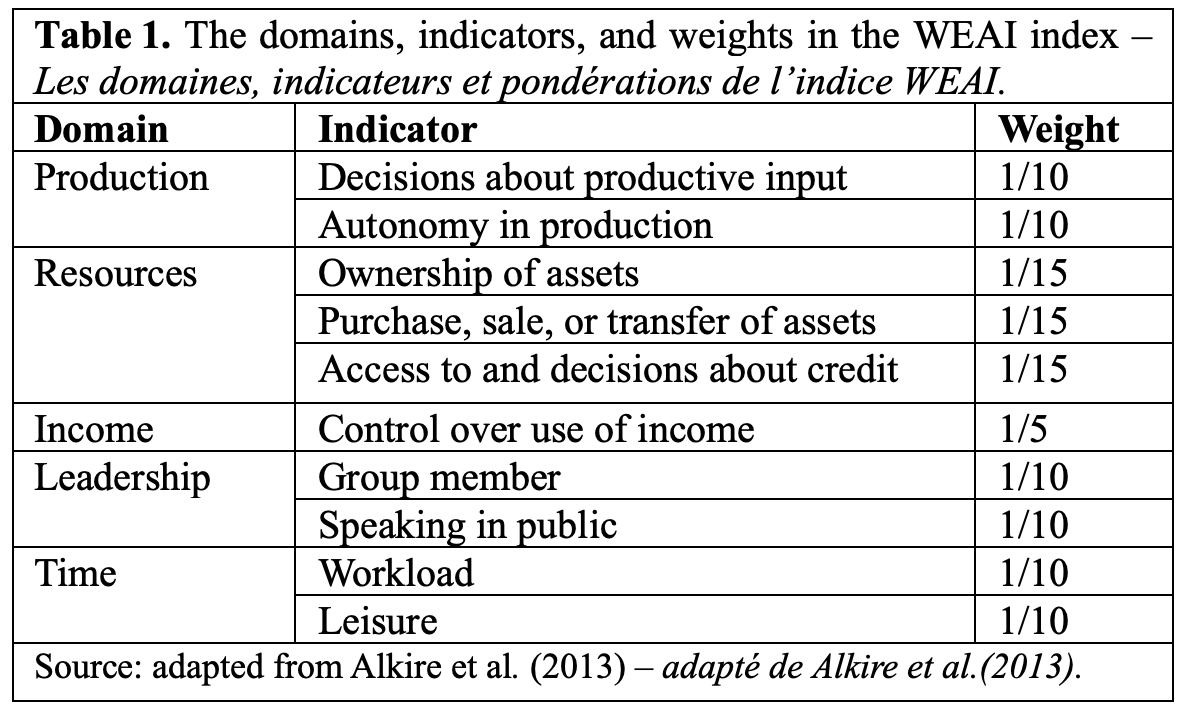
46Through these methodological controls, the application of the WEAI to the INStaD dataset allows for a rigorous and nationally representative assessment of women’s empowerment across all departments of Benin. In line with the WEAI framework, five domains encompassing 10 indicators were defined (see Table 1). Each domain was assigned equal weight, as were the indicators within each domain, ensuring balanced representation of the multidimensional nature of empowerment.
47The five empowerment domains (5DE) are measured by a number between 0 and 1, with the higher value of 1 signifying greater empowerment. The formula for calculating the 5DE is as follows:

48where H is the proportion of inadequate individuals (taking all 10 indicators into account). An individual is inadequate when the weighted sum of the values of the 10 indicators (inadequacy score) is strictly greater than 0.2 (20%) (Doubogan, 2017). In other words, an individual is adequate when the inadequacy score for the 10 indicators is less than or equal to 0.2 (20%); A is the average inadequacy score, i.e. the proportion of domains in which inadequate individuals have not reached a satisfactory level. To reach a satisfactory level in a given domain, the inadequacy score of the domain indicators must be less than or equal to 20% (Alkire et al., 2013) ; M0: the inadequacy index.
49This formula shows that the women's 5DE index can be improved by reducing the percentage of inadequate women (H), or the proportion of areas in which inadequate women do not have a satisfactory level.
50In addition, the Gender Parity Index (GPI) reflects the percentage of women who have achieved the same level of autonomy as men in their households. For households where gender parity has not yet been achieved, the GPI sub-index shows the overall gap to be bridged by women to reach the same level of autonomy as men. GPI is also measured by a number between 0 and 1, with the higher value of 1 indicating greater gender parity.
51The formula for calculating the GPI index is :

52with HGPI: proportion of households without gender parity; IGPI: average empowerment gap, indicating the difference women need to bridge to reach the same level of autonomy as their male counterparts.
53Based on the two sub-indices 5DE and GPI, the WEAI is then an aggregate index that shows, on the one hand, the level of empowerment of women in their households and in the community and, on the other, the level of inequality between women and men within the household. The 5DE empowerment index accounts for 90% of the WEAI value, while the gender parity index (GPI) contributes 10% (Lukyamuzi et al., 2025).
54The WEAI formula is as follows:

55Improvement in either the 5DE or GPI index leads to an overall improvement in the WEAI. The WEAI is then generated for each mode of women's land ownership in each household. It is then possible to model the factors influencing this women's empowerment index. Various models, including two-stage regression analysis (Kanono, 2015) and the binomial logit model (Bashir et al., 2013; Sheikh et al., 2013; Abdullah et al., 2019) were used to determine the factors influencing household vulnerability to women's empowerment. Sharaunga et al. (2015) also used the binomial logit model to assess the impact of women's empowerment in agriculture on household vulnerability to food insecurity. This study used the logit model and in the binary logistic regression framework, there is one dependent variable which therefore takes two possible modalities since: the WEAI is transformed into a binary variable that takes the value of 1 for empowered women (a woman is considered autonomous here if she has achieved satisfactory results in four of the five empowerment domains, or if she has achieved satisfactory results in at least 80% of the weighted indicators or if her WEAI index is greater than 0.2 [Alkire et al., 2013]) and a value of 0 for the non-empowered woman (WEAI less than or equal to 0.2 [Alkire et al., 2013]). Essentially, the estimated logistic regression gives the probability of a woman falling into one of these two categories as a function of one or more explanatory variables, which can be continuous or categorical (Pervaiz et al., 2017; Abdullah et al., 2019). The cumulative logistic model can be expressed econometrically as shown in equation 4:

56where Pi is the probability of a household being autonomous given Xi; Y = 1 indicates an autonomous household; Xi represents the ith explanatory variable for women's autonomy; β0 and βi are regression coefficients; and e is the base of the natural logarithm.
57Equation 4 can also be written as follows:

58where Zi = (β0 + ∑βiXi). Equation 5 is known as the cumulative logistic distribution function. If Pi is the probability of a woman being autonomous, then 1 - Pi is the probability of a household being non-autonomous. Therefore:

59Equation 6 can be rearranged to:

60The term Pi ⁄ (1 - Pi) is called the odds ratio in favor of women's autonomy, representing the ratio of the probability of being autonomous to the probability of being non-autonomous. Taking the natural logarithm of Equation 7, we get:

61Here, Li is the log of the odds ratio and is known as the logit or logistic regression model for women's empowerment. After incorporating the disturbance term μ into Equation 8, the logit model is:

62The parameters β0 and β1, β2 … βn in Equation 9 are estimated using the maximum likelihood (ML) method.
63Descriptions of the variables thought to influence women's empowerment and included in the empirical model are given in the following table. These variables include household size, women's land access patterns in addition to other household socio-economic characteristics. Socio-economic characteristics influencing women's empowerment include household income, age of household head, education level, group membership, marital status of household head and area farmed (Hounkpatin et al., 2025). Given that women in rural areas are largely dependent on agriculture for their livelihoods (Souratie et al., 2019), women's empowerment is greatly influenced by their level of access to productive resources including land that affect agricultural productivity (Doubogan, 2017). It has been hypothesized that women's access to and control over physical/material assets is positively associated with the likelihood of a woman becoming self-reliant because these assets are essential to the pursuit of sustainable agricultural and off-farm livelihood strategies. These assets include ownership and control of land and land areas, as well as the goods and services they produce (Kadjegbin et al., 2018).
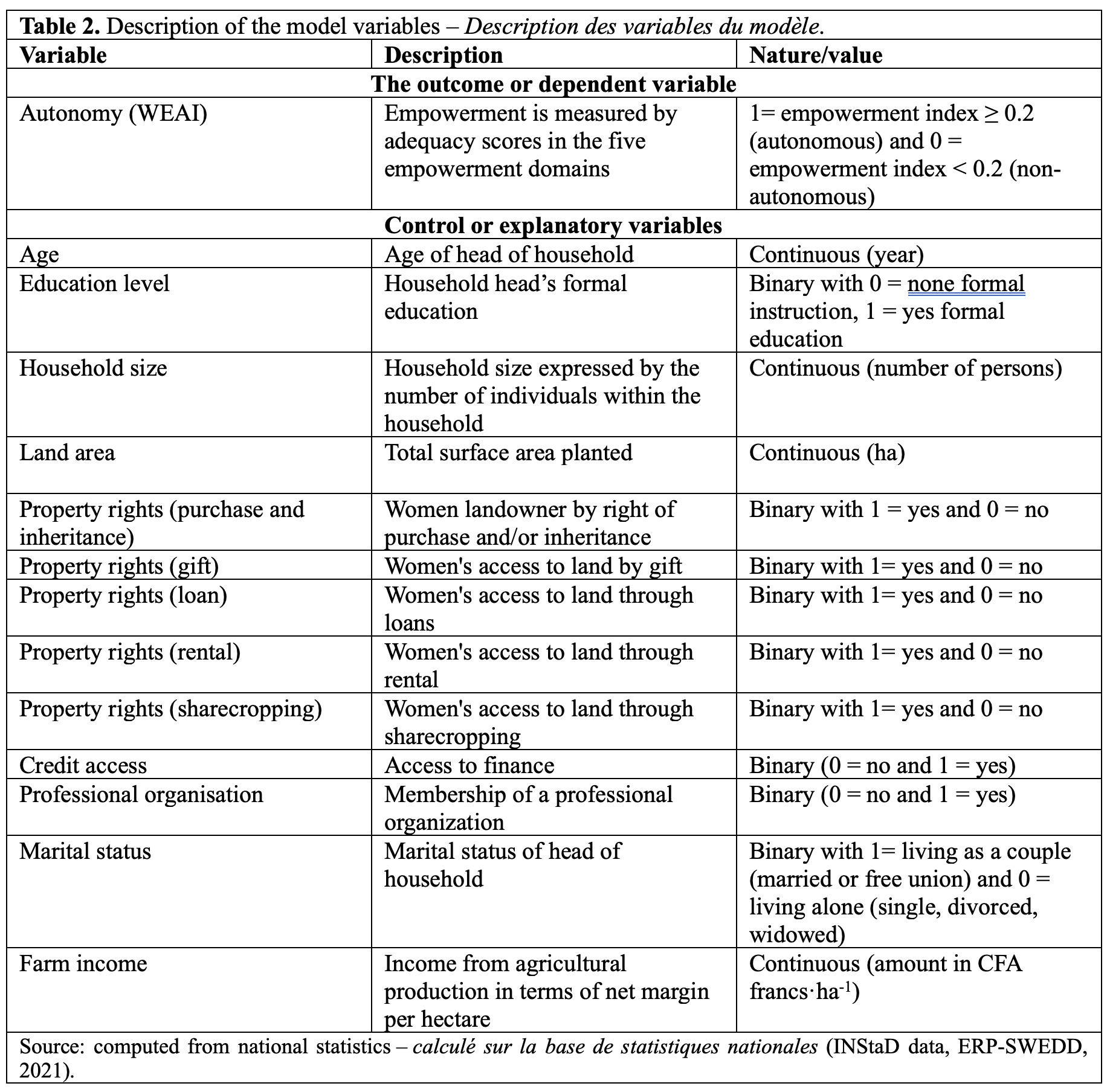
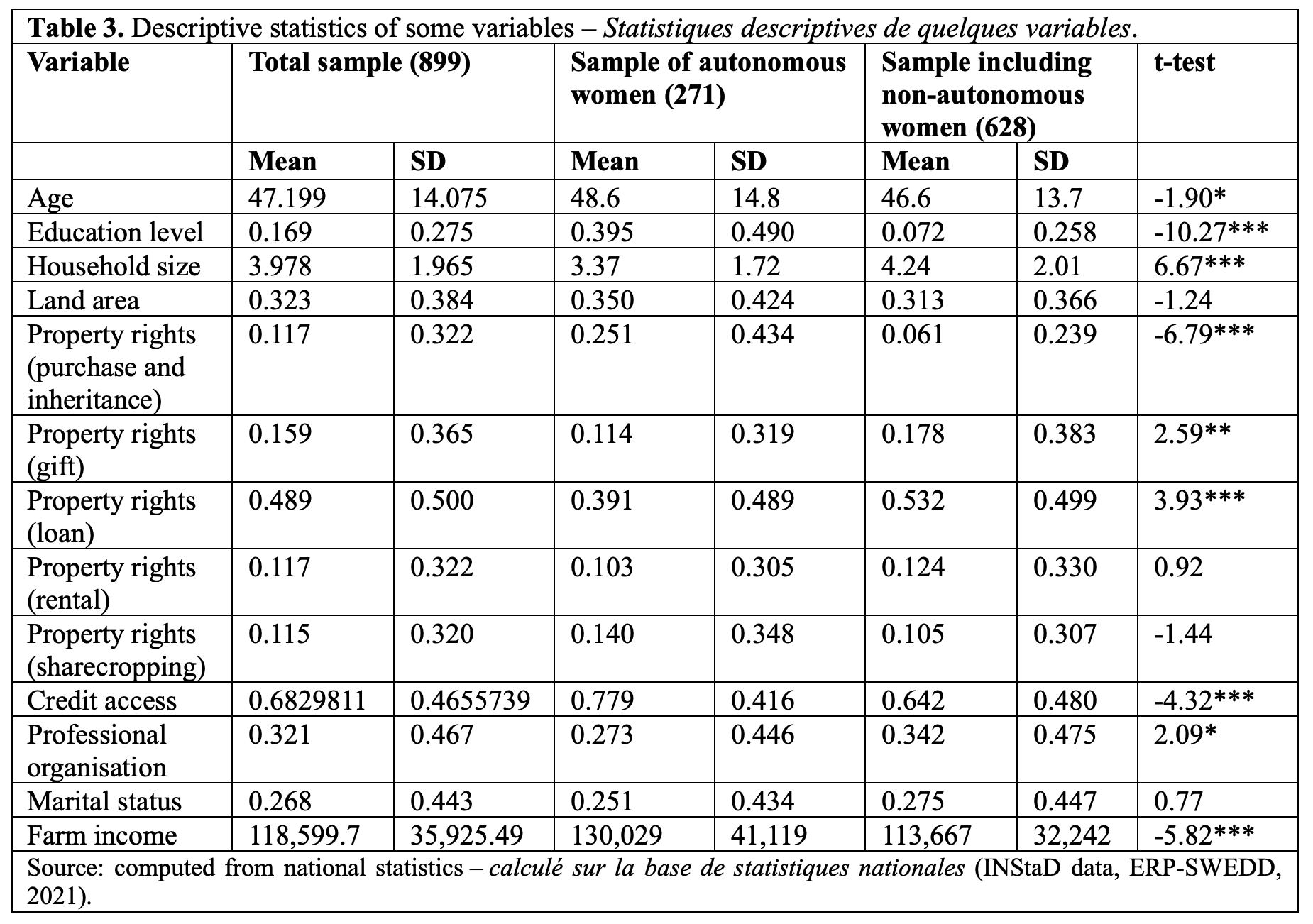
64The description of the variables that are used in this research is presented in table 2 and the describable statistics in table 3.
65We have strengthened the empirical strategy by explicitly testing for multicollinearity, model specification, and potential endogeneity concerns.
66First, we assessed multicollinearity using the Variance Inflation Factor (VIF). The mean VIF is 1.44, which is well below commonly accepted thresholds (e.g., 5 or 10), indicating no problematic collinearity among the explanatory variables (Gujarati & Porter, 2009).
67Second, we evaluated model specifications using the Ramsey RESET test. The test yields F = 3 with p < 0.01, suggesting potential functional form misspecification. To address this, we estimated alternative model specifications, including nonlinear terms and reduced-form models. The main results remain qualitatively unchanged, confirming the stability of our findings.
68Third, we report information criteria (AIC = 1,580.65; BIC = 1,695.28), which support a parsimonious specification relative to alternative models.
69Finally, regarding endogeneity, we acknowledge that certain covariates (e.g., land rights) may be jointly determined with women’s autonomy. While data limitations prevent the use of strong external instruments, we mitigate this concern by (i) including a rich set of control variables capturing socioeconomic and household characteristics, and (ii) testing alternative specifications. The consistency of results across these specifications suggests that endogeneity is unlikely to drive the main conclusions.
4. RESULTS
4.1. Household characteristics in the study area
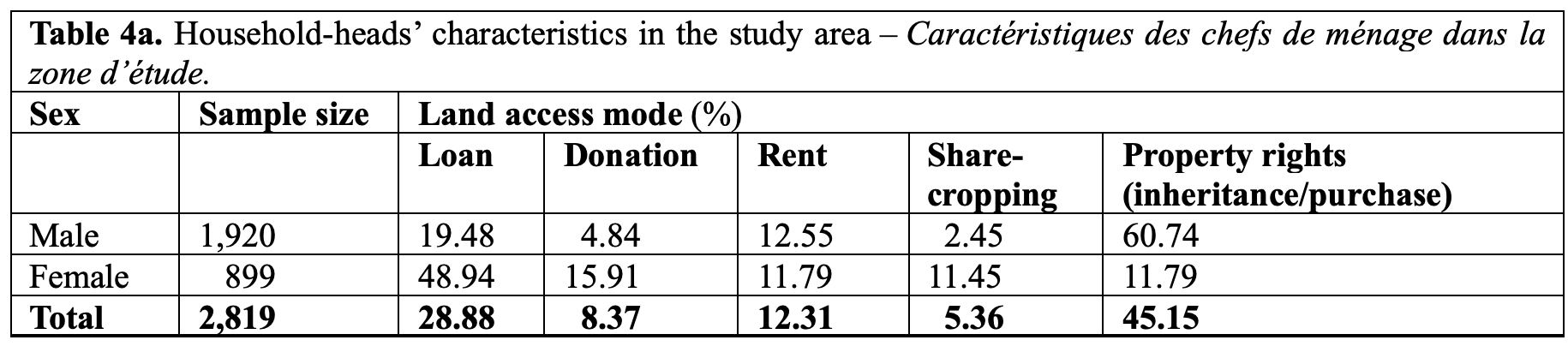
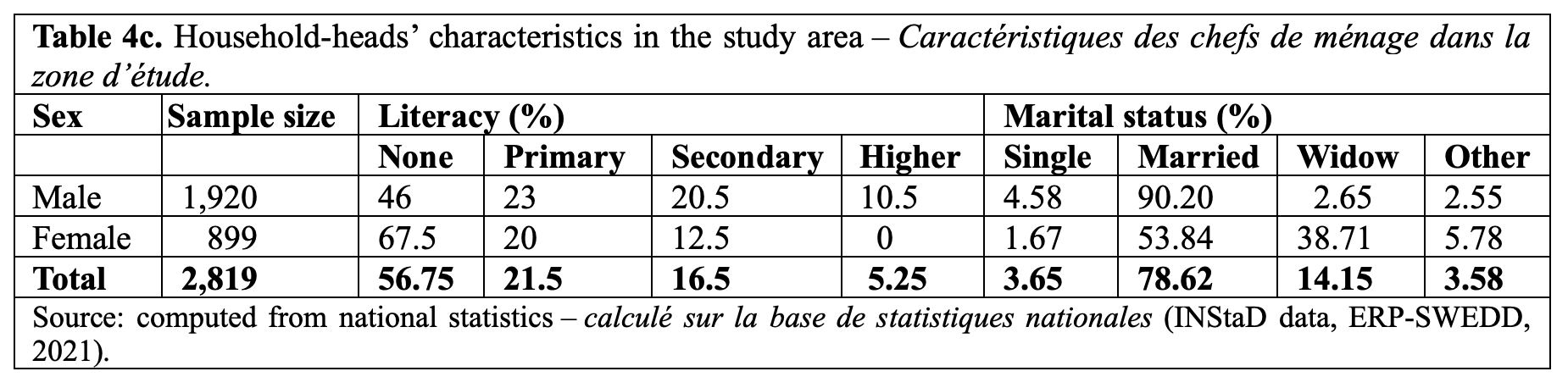
70In Benin, women mainly have access to land by indirect means, such as loans (48.94%), sharecropping (11.45%), rental (11.79%) and donation (15.91%) (Table 4a). In contrast to indirect access, 60.74% of men own their land (through purchase or inheritance), compared with only 11.79% of women. In terms of access to credit, 36% of households in the study area have access (Table 4b). In fact, women (60%) have a higher rate of access to credit than men (40%). The average age of women in the study area is 47, compared with 42 for men. Women farm an average of 0.3 ha, compared with 2.3 ha for men (Table 4b). Over half (67.5%) of women and over a third (46%) of men have no education. Roughly, the same proportion of women and of men have primary education level (respectively 20% and 23%). These figures are more contrasted for secondary education (20.5% for men and 12.5% for women). None of the women in the sample attained education beyond the secondary level, whereas approximately, 10% of men held a university degree. About half the women in the sample are married (53.84%) or widowed (38.71%) (Table 4c).

4.2. Global Women Empowerment in Agriculture Index (WEAI)
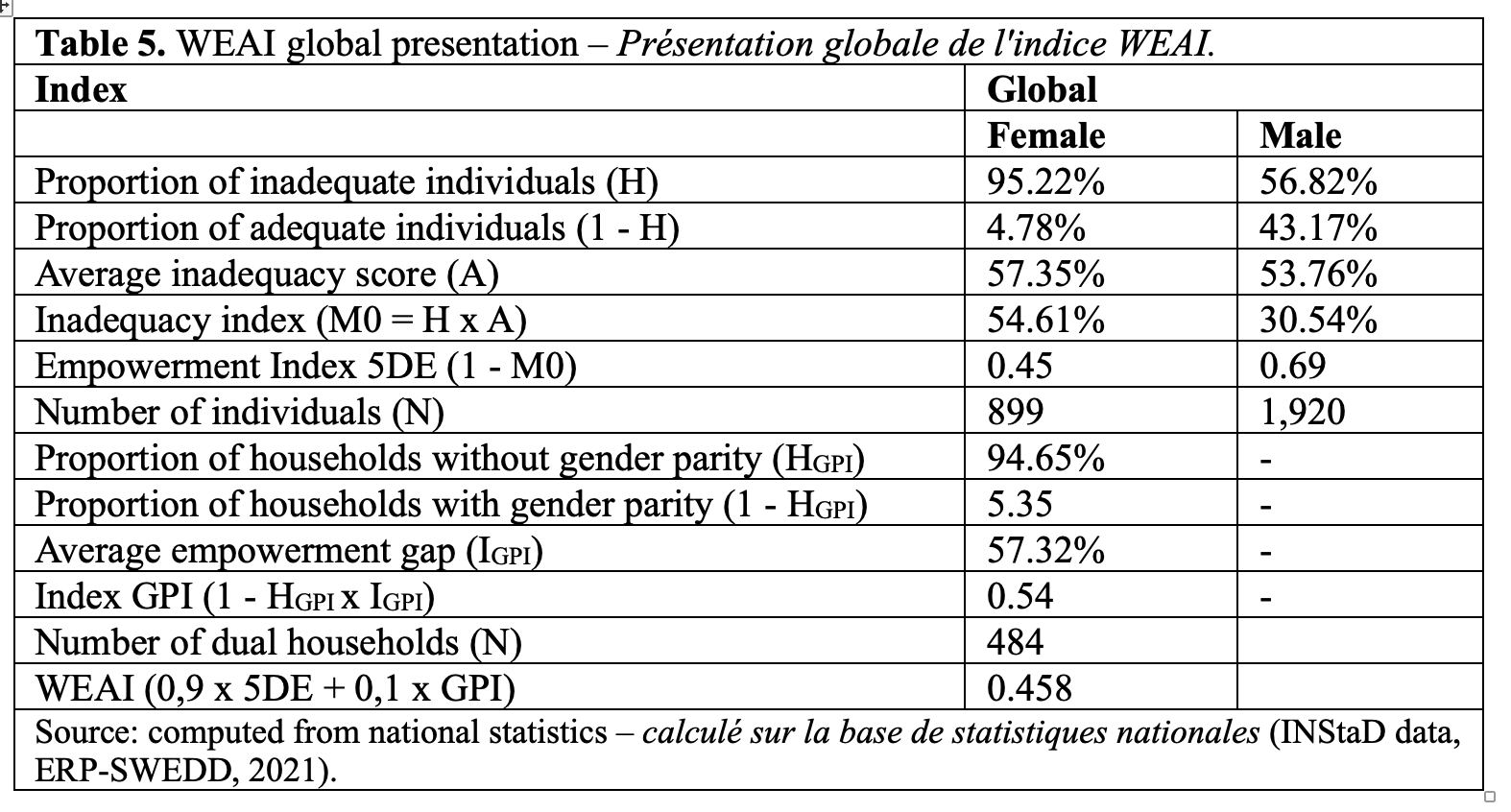
71Triangulation of the empirical data reveals that an individual is considered globally inadequate for the ten 5DE indicators when the weighted sum of their values (inadequacy score) exceeds 20%. The findings reveal a very high level of inadequacy across the ten indicators of the Five Domains of Empowerment (5DE) within the study community. Specifically, 95.22% of women are classified as disempowered (Table 5), indicating that only 4.78% reach the established empowerment threshold. This result reflects limited female participation in household decision-making and agricultural activities.
72Comparative analysis shows that men exhibit higher levels of empowerment across all five domains: – production decisions;
73– access to and control over resources;
74– income management;
75– leadership and community participation;
76– time allocation.
77Among women identified as disempowered (95.22%), the average empowerment deficit is 57.35%, implying that they fall short of the required adequacy threshold in more than half of the assessed indicators (Table 5). This substantial deficit underscores the magnitude of gender disparities in decision-making power.
78These inequalities are further reflected in the 5DE index scores, which stand at 0.45 for women and 0.69 for men. The pronounced gap between these scores highlights a significant gender imbalance to the detriment of women, indicating their relative marginalization in both household governance and agricultural management.
79Moreover, table 5 shows that 94.65% of households (HGPI)do not achieve gender parity in decision-making. In the majority of surveyed households, women remain underrepresented in strategic decisions concerning domestic management and farm-related activities.
80These results underscore the need for targeted interventions aimed at strengthening women's access to productive resources, improving their decision-making power, and promoting more inclusive domestic and agricultural governance. They also highlight the importance of land reforms and public policies that promote gender equality in order to reduce the observed structural inequalities. In only 5.35% of households (1-HGPI) do women have equal or greater participation in decision-making than men. Furthermore, in households where gender parity is not respected, women face average gap of 57.32% (IGPI) in autonomy compared to their male counterparts. With Benin's Women's Empowerment Index (5DE) and Gender Parity Index (GPI) at 0.45 and 0.535 respectively, the overall WEAI stand at 0.458 (Table 5). Women's participation in household decision-making is particularly low, with only 4.78% adequately involved in decision-making processes (1-H) within both the household and on farms. This indicates that men predominantly control decision-making in Benin's agricultural areas.
4.3. Women's empowerment level following various types of access mode to land
81Based on the results presented in figure 1, the 5DE empowerment index for women is highest for those working on plots acquired through inheritance or purchase (0.478), followed by sharecroppers (0.434), land tenants (0.313),) and those with plots obtained through loan (0.256). Women's participation in household decision-making (5DE) is greater for those owning plots and, to a lesser extent, for sharecroppers (empowerment indices of 0.478 and 0.434, respectively) compared to other forms of land access such as rental (0.313) and loan (0.256). Expanding women’s ownership of agricultural land through inheritance or purchase could enhance their empowerment. Land security encourages women to invest in soil fertility and improve agricultural productivity without the fear of expropriation (Hounkpatin et al., 2025).
82The observed variations in gender parity and in the average gender empowerment gap across different land acquisition modes suggest that the nature of land rights differentially affects intra-household decision-making dynamics. Certain modes of acquisition – such as land purchase – are associated with relatively higher levels of gender parity. In contrast, acquisition through inheritance or gifts may perpetuate or reinforce pre-existing gender inequalities.
83This heterogeneity indicates that not only access to land, but also the quality and security of land rights, play a critical role in shaping women’s bargaining power within the household. Land acquired through purchase often confers stronger tenure security, which may enhance women’s capacity to participate in decisions regarding agricultural production, income allocation, and investment. Conversely, land accessed through customary or socially mediated mechanisms may provide nominal rights without guaranteeing effective control. As a result, women’s decision-making authority may remain constrained despite formal or customary recognition of rights. Therefore, more secure and individualized land rights appear to reduce the gender empowerment gap, whereas precarious or socially conditioned access can exacerbate women’s economic dependence and decision-making marginalization. Notably, the women’s empowerment in agriculture index is highest among women who own land (0.490), followed by those with land use rights through sharecropping (0.440), rental agreements (0.331), and loans (0.280).
Figure 1. WEAI according to women’s land access modes – WEAI selon les modes d'accès des femmes au foncier.
Source: computed from national statistics – calculé sur la base de statistiques nationales (INStaD data, ERP-SWEDD, 2021).
4.4. Determinants of women's empowerment in the agricultural sector
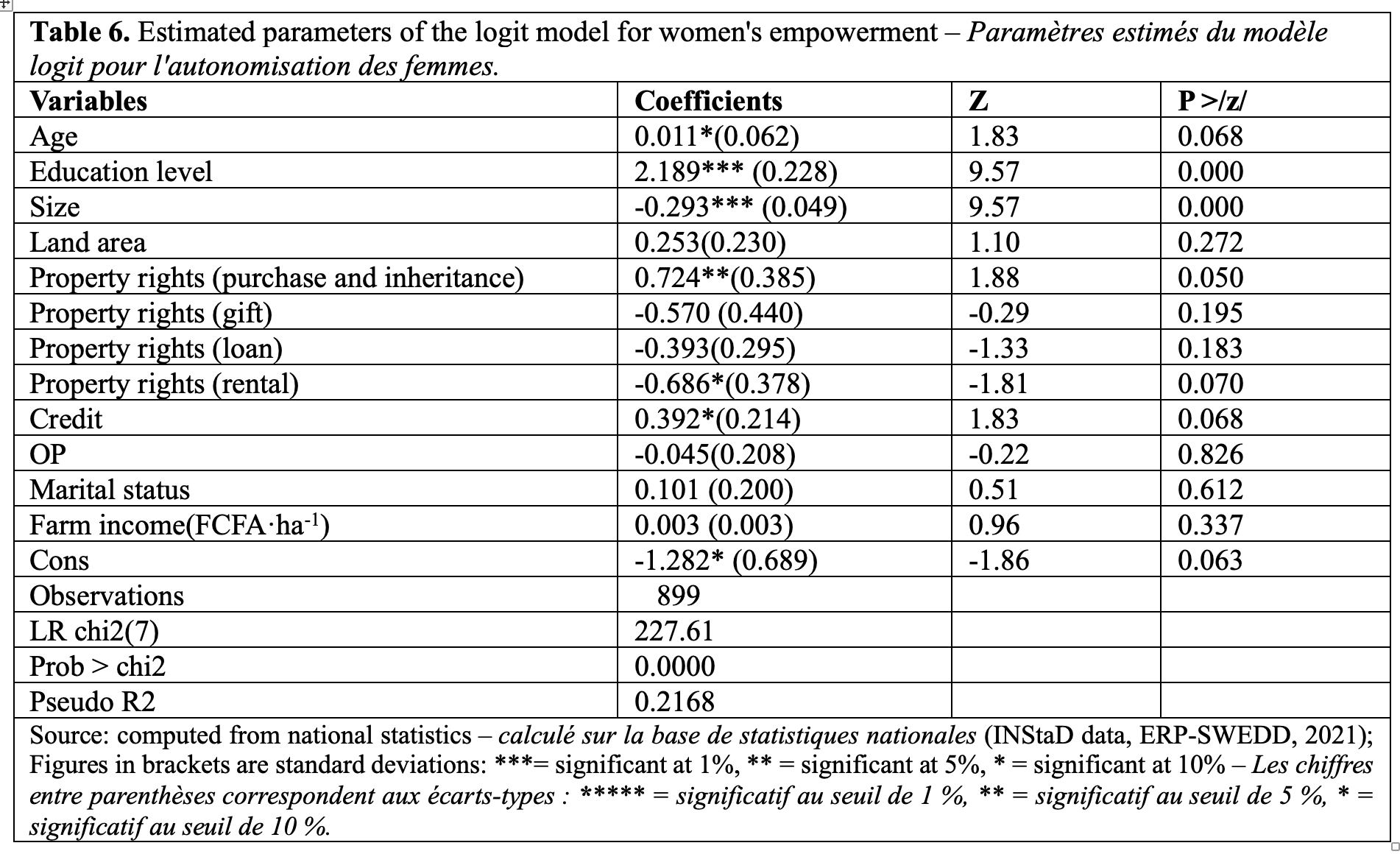
84The estimated parameters and marginal effects of the significant variables derived from the regression analysis on the determinants of women's empowerment in the agricultural sector are presented in table 6. Six explanatory variables with statistically significant coefficients were retained from the analysis in table 6: land rights (purchase and inheritance), land rights (rental), level of education, household size, age, and credit. The coefficient for property rights (purchase and inheritance) is positive, indicating that greater land ownership is associated with increased female empowerment in the household (Sraboni et al., 2014; Goli et al., 2025). In other words, when women own more land, their decision-making power and living conditions improve (Stanley et al., 2015; Goli et al., 2025). Conversely, women who rent agricultural land or belong to larger households tend to have lower levels of empowerment. Renting land reduces women’s autonomy, while larger households increase daily expenses, which in turn diminishes their decision-making power. Furthermore, woman's education and age significantly influence their level of empowerment: higher education increases the likelihood of household autonomy (Devi et al., 2024), and older age also contributes, though to a lesser extent. Access to credit further enhances women’s chances of autonomy. Variables such as marital status, available area, farm income (FCFA·ha-1), farmers' organization membership (OP), land rights (gift), land rights (loan) and land rights (rental) do not significantly affect women's empowerment in the area.
85Overall, property rights increase the probability of women's empowerment in the household by 11.4 percentage points. Educated women are 34.5 times more likely to participate in household decision-making, while older women are 1.4 times more likely to do so, while access to MFI credit increases their empowerment probability by 6.1 percentage points.
5. DISCUSSION
86The application of the Women’s Empowerment in Agriculture Index (WEAI) in Benin highlights the multidimensional and interdependent nature of women’s empowerment. The fact that only 4,78% of women participate in decisions related to agricultural production reveals a high concentration of decision-making power in the hands of men. This low participation in the five key areas – production, resources, income, leadership, and time management – reflects not only persistent gender inequalities but also potential inefficiencies in resource allocation within farming households (Quisumbing et al., 2021).
87These findings confirm that empowerment cannot be understood as an isolated variable. It results from the interaction of economic, institutional, and sociocultural factors. In this regard, women's empowerment is associated with gains in agricultural productivity and social well-being (Anik & Rahman, 2020), as well as positive externalities in terms of health and access to services (Fielding & Lepine, 2017).
88In this context, the feminization of agriculture in Benin, partly linked to male migration, is not limited to an increase in women's participation in productive activities. It is accompanied by a shift towards subsistence farming, often constrained by limited access to productive resources (FAO, 2011). However, this increased centrality of women in agricultural production does not automatically translate into greater empowerment. Empirical results show that effective control of land remains a determining factor in decision-making power.
89The role of income also appears central to the dynamics of empowerment. Increased female contributions to household expenses are positively correlated with women's participation in decision-making, which aligns with models of intra-family negotiation where power depends on individually controlled resources. However, as Kabeer (2002) points out, economic power does not automatically confer decision-making power, particularly in contexts marked by patriarchal norms.
90Assessing this relationship remains challenging due to the shortcomings of existing measurement tools. While the WEAI index quantifies several important dimensions of empowerment, it does not fully capture its qualitative aspects, notably social norms, intra-family power relations, and subjective perceptions (International Food Policy Research Institute, 2012). In the Beninese context, these dimensions play a crucial role in women's actual capacity to exercise decision-making power, regardless of their economic involvement. Therefore, the interpretation of the results must incorporate these persistent socio-cultural constraints.
91Furthermore, the low levels of women's participation in decision-making must be considered within the context of diverse socio-institutional frameworks. Customary norms, kinship systems, and land practices vary across regions and socio-cultural groups, influencing access to resources and decision-making power in different ways (Meinzen-Dick et al., 2014). This heterogeneity helps explain the persistence of low levels of empowerment, even in contexts where women play a central economic role.
92In this context, land ownership emerges as a key driver of empowerment. Secure access to land not only strengthens decision-making power but also influences agricultural practices and production strategies. Women play a crucial role in activities such as sowing, water management, seed selection, and crop diversification, contributing to the sustainability of agricultural systems.
93The distinction between subsistence farming, often practiced by women, and commercial agriculture, more frequently controlled by men, reflects differing approaches to resource use. While the former contributes to household food security, the latter prioritizes economic profitability. Thus, women's access to land is of collective importance, supporting both food resilience and environmental sustainability.
94Finally, education and access to credit are complementary levers for empowerment. Education strengthens analytical skills, access to information, and self-confidence, thereby fostering sustainable empowerment (Tomavo & Degla, 2019). Similarly, financial inclusion improves women's investment capacity, although its effectiveness depends on the institutional context and financial literacy support.
95These results highlight the need for integrated approaches combining land tenure security, financial inclusion and transformation of social norms.
6. CONCLUSIONS
96This study reveals a low overall level of empowerment among rural women in Benin, with only 4,78% reporting active participation in decisions related to agricultural production and household management. The observed gap in the Five Domains of Empowerment (5DE) index (0.45 for women compared to 0.70 for men) confirms the presence of a structural asymmetry in control over productive resources and decision-making authority. However, these inequalities cannot be interpreted independently of the land tenure and territorial contexts in which they are embedded.
97Our findings show that women who hold land ownership rights achieve higher levels of empowerment (5DE = 0.50) than those who access land through indirect arrangements such as borrowing, sharecropping, or rental agreements. This result underscores the central importance of land tenure security as a determinant of agency. Nevertheless, access to land is shaped by broader structural dynamics. Large-scale land acquisitions reduce the availability of agricultural land for rural communities, intensifying competition and disproportionately constraining women’s access, particularly in contexts where customary and inheritance systems already disadvantage them.
98At the intra-household level, forms of “family-based land appropriation” further restrict women’s effective land rights. Even where statutory reforms formally recognize gender equality, customary norms may limit women’s inheritance rights or condition land use on male authority. These informal institutional mechanisms perpetuate tenure insecurity, reduce incentives to invest in sustainable agricultural practices, and weaken women’s bargaining power within households.
99Importantly, these dynamics are not spatially uniform. Land tenure systems, socio-cultural norms, and economic pressures vary between southern regions characterized by high demographic density and intense land pressure, and northern regions where land abundance and distinct social institutions prevail. Regional disaggregation of the data would allow for the identification of territorial disparities in empowerment outcomes and in the effects of land rights.
100Overall, the empowerment of rural women depends not only on individual-level factors such as education, income, or access to credit, but also on structural conditions related to land governance, rural transformation processes, and intra-household power relations. Policies aimed at strengthening women’s empowerment in agriculture should therefore integrate:
101– the legal recognition and effective enforcement of women’s land rights;
102– improved regulation and transparency of large-scale land acquisitions;
103– alignment of statutory reforms with customary inheritance practices;
104– territorially differentiated approaches adapted to regional socio-economic contexts.
105Ultimately, women’s access to land should be understood not solely as a matter of gender equality, but also as a question of distributive justice, environmental sustainability, and the long-term economic resilience of rural areas.
Bibliographie
Abdullah et al., 2019. Factors affecting household food security in rural northern hinterland of Pakistan. J. Saudi Soc. Agric. Sci., 18(2), 201-210, doi.org/10.1016/j.jssas.2017.05.003
Abrar-ul-haq M., Jali M.R.M. & Islam G.M.N., 2017. Empowering rural women in Pakistan: empirical evidence from Southern Punjab. Qual. Quant., 51, 1777-1787, doi.org/10.1007/s11135-016-0365-7
Agarwal B., 1994. A field of one's own: gender and land rights in South Asia. Cambridge, UK: Cambridge University Press.
Akanro R., Kede G.R., Attanasso M.O. & Dossou J., 2023. Access to land and empowerment of women organic cashew producers in the Collines Department of Benin. Int. J. Res. Sci. Innovation, 10(10), 264-275, doi.org/10.51244/IJRSI.2023.101026
Alkire S. et al., 2013. The women’s empowerment in agriculture index. World Dev., 52, 71-91, doi.org/10.1016/j.worlddev.2013.06.007
Allendorf K., 2007. Do women’s land rights promote empowerment and child health in Nepal? World Dev., 35(11), 1975-1988, doi.org/10.1016/j.worlddev.2006.12.005
Anderson S. & Eswaran M., 2009. What determines female autonomy? Evidence from Bangladesh. J. Dev. Econ., 90(2), 179-191, doi.org/10.1016/j.jdeveco.2008.10.004
Anik A.R. & Rahman, S. 2020. Empowerment of women in agriculture: level, inequality, progress and impact on productivity and efficiency. J. Dev. Stud., 56(8), 1502-1520, doi.org/10.1080/00220388.2020.1817393
Bashir M.K., Schilizzi S. & Pandit R., 2013. Impact of socio-economic characteristics of rural households on food security: the case of the Punjab, Pakistan. J. Anim. Plant Sci., 23(2), 611-618.
Batliwala S., 1995. Defining women’s empowerment: a conceptual framework. In: Education for women's empowerment. New Delhi: Asian-South Pacific Bureau of Adult Education.
Byamugisha F.F.K. & Dubosse N., 2023. The investment case for land tenure security in Sub-Saharan Africa. J. Benefit-Cost Anal., 14(S1), 272-300, doi.org/10.1017/bca.2023.14
Dahoun D.B. et al., 2013. Microcrédit, pauvreté et autonomisation des femmes au Bénin. PEP working papers serie 2013-13, 1-44, doi.org/10.2139/ssrn.3167989
Degla K.P., Tomavo D.M.E. & Badou G., 2016. Gender-based analysis of income diversification as a strategy for poverty reduction in central Benin (West Africa). Int. J. Adv. Res., 4(9), 840-854, doi.org/10.21474/IJAR01/1552
Devi S., Thinakaran R., Hanefar S.B.M. & Nadzri N.R.M., 2024. Tracking academic contributions to women's empowerment in Malaysia: a bibliometric investigation. Heliyon, 10(17), e37052, doi.org/10.1016/j.heliyon.2024.e37052
Doss C., 2006. The effects of intrahousehold property ownership on expenditure patterns in Ghana. J. Afr. Econ., 15(1), 149-180, doi.org/10.1093/jae/eji025
Doubogan Y.O., 2017. Analyse du niveau d'autonomisation des femmes dans l'agriculture à partir de l'application du « Women's Empowerment in Agriculture Index (WEAI) » : étude de cas du Bénin. Rev. Études Multidisciplinaires Sci. Écon. Sociales, 2(1), 1-19.
Ellé A.A., 2022. Analyse des déterminants de l’autonomisation des femmes dans l’Union Économique et Monétaire Ouest Africaine (UEMOA). Rev. Fr. Écon. Gestion, 3(5), 367-387.
Fanelli R.M., 2022. Bridging the gender gap in the agricultural sector: evidence from European Union Countries. Soc. Sci., 11(3), 105, doi.org/10.3390/socsci11030105
FAO, 2011. The state of food and agriculture 2010–2011: women in agriculture – closing the gender gap for development. Roma: FAO.
Fielding D. & Lepine A., 2017. Women's empowerment and well-being: evidence from Africa. J. Dev. Stud., 53(9), 1419-1433, doi.org/10.1080/00220388.2016.1219345
Ganle J.K., Afriyie K. & Segbefia A.Y., 2015. Microcredit: empowerment and disempowerment of rural women in Ghana. World Dev., 66, 335-345, doi.org/10.1016/j.worlddev.2014.08.027
Goli I. et al., 2025. Toward tenure security: the relationship between women's land ownership, formal land title documents and their empowerment. Land Use Policy, 148(1), 107389, doi.org/10.1016/j.landusepol.2024.107389
Gouvernement du Benin, 2013. Loi n°2013-01 du 14 août 2013. Loi portant Code foncier et domanial en République du Bénin. Cotonou : République du Bénin.
Gujarati D.N. & Porter D.C., 2009. Basic econometrics. 5th ed. New York, NY, USA: McGraw-Hill.
Han W. et al., 2024. Incorporating environmental capacity considerations to prioritize control factors for the management of heavy metals in soil. J. Environ. Manage., 351(1), 119820, doi.org/10.1016/j.jenvman.2023.119820
Hare D., Yang L. & Englander D., 2007. Land management in rural China and its gender implications. Feminist Econ., 13(3-4), 35-61, doi.org/10.1080/13545700701445298
Hounkpatin J.P. et al., 2025. Promoting women autonomy in the agricultural sector: is productivity land access mode wise and gender differentiated? Land Use Policy, 157, 107656, doi.org/10.1016/j.landusepol.2025.107656
INStaD (Institut National de la Statistique et de la Démographie), 2021. Étude de base des indicateurs du projet SWEDD assortie d’une cartographie dans les 77 communes d’intervention du projet. Rapport d’enquête. Cotonou : INSTaD.
International Food Policy Research Institute (IFPRI), 2012. Women’s Empowerment in Agriculture Index (WEAI). Washington, DC: IFPRI.
Kabeer N., 2002. Resources, agency, achievements: reflections on the measurement of women’s empowerment. Dev. Change, 30(3), 409-464, doi.org/10.1111%2F1467-7660.00125
Kabeer N., 2005. Gender equality and women's empowerment: a critical analysis of the third Millennium Development Goal. Gender Dev., 13(1), 13-24.
Kadjegbin T.R.G. et al., 2018. Influences des modes d’accès a la terre sur la production agricole dans les communes de Dassa-Zoumé et de Glazouè au centre du Bénin. Eur. Sci. J., 14(6), 412-431, doi.org/10.19044/esj.2018.v14n6p412
Kanono T., 2015. Determinants of vulnerability to livelihood insecurity at household level: evidence from Maphutseng, Lesotho. J. Agric. Extension, 19(2), 1-20, doi.org/10.4314/jae.v19i2.1
Kieran C. et al., 2015. Examining gender inequalities in land rights indicators in Asia. Agric. Econ., 46(S1), 119-138, doi.org/10.1111/agec.12202
Lawin K.G., 2017. Droits de propriété foncière, aversion au risque et performance des petits producteurs agricoles. Thèse de doctorat : Université Laval, Québec (Canada).
Lukyamuzi V., Livingstone S., Namagembe S. & Nantumbwe S., 2025. Analysis of the impact of women's empowerment and social network connections on the adoption and sustained use of clean cooking fuels and technologies in Uganda. Energy Policy, 198, 114435, doi.org/10.1016/j.enpol.2024.114435
Meinzen-Dick R. et al., 2014. The gender asset gap and its implications for agricultural and rural development. In: Quisumbing A.R. et al., eds. Gender in agriculture: closing the knowledge gap. Springer, 91-115, doi.org/10.1007/978-94-017-8616-4_5
Millennium Challenge Corporation (MCC), 2020. Benin II power compact: land tenure security and modernization project. Washington, DC: MCC.
Mishra K. & Sam A.G., 2016. Does women’s land ownership promote their empowerment? Empirical evidence from Nepal. World Dev., 78, 360-371, doi.org/10.1016/j.worlddev.2015.10.003
N’cho N’cho H.-B., 2020. Effet du microcrédit sur la probabilité d’autonomisation des femmes en Côte d’Ivoire. In : Actes de la deuxième conférence internationale sur la Francophonie économique, L’entrepreneuriat et l’insertion professionnelle des jeunes et des femmes en Afrique francophone, 2-4 mars 2020, Université Mohammed V de Rabat, Maroc. Montréal, Canada : Université de Montréal ; Rabat : CIRPEC, 410-421, https://ofe.umontreal.ca/fileadmin/ofe/documents/Actes/Conf_OFE_CIRPEC_2020/Texte29_Ncho.pdf
Pervaiz B., Ninghui L., Manzoor M.Q. & Altangerel O., 2017. Determinants of household food security in Punjab – Pakistan: a binary logistic regression analysis. World Appl. Sci. J., 35(7), 1021-1028, doi.org/10.5829/idosi.wasj.2017.1021.1028
Quisumbing A.R., Sproule K., Martinez E.M. & Malapit H., 2021. Do tradeoffs among dimensions of women's empowerment and nutrition outcomes exist? Evidence from six countries in Africa and Asia. Food Policy, 100, 102001, doi.org/10.1016/j.foodpol.2020.102001
Samarakoon S. & Parinduri R.A., 2015. Does education empower women? Evidence from Indonesia. World Dev., 66, 428-442, doi.org/10.1016/j.worlddev.2014.09.002
Sen K.K., Chapman A.J. & Saha B.B., 2024. Women's empowerment: a catalyst for addressing energy poverty and energy inequality in developing countries. Energy, 313, 133982, doi.org/10.1016/j.energy.2024.133982
Sharaunga S., Mudhara M. & Bogale A., 2015. The impact of ‘women's empowerment in agriculture’ on household vulnerability to food insecurity in the KwaZulu-natal province. Forum Dev. Stud., 42(2), 195-223, doi.org/10.1080/08039410.2014.997792
Sheikh A.D., Rehman T. & Yates C.M., 2003. Logit models for identifying the factors that influence the uptake of new ‘no-tillage’ technologies by farmers in the rice – wheat and the cotton – wheat farming systems of Pakistan's Punjab. Agric. Syst., 75(1), 79-95, doi.org/10.1016/S0308-521X(02)00014-8
Souratié W., Koinda F., Decaluwé B. & Samandoulougou R., 2019. Politiques agricoles, emploi et revenu des femmes au Burkina Faso. Rev. Écon. Dév., 27(3), 101-127.
Sraboni E., Malapit H.J., Quisumbing A.R. & Ahmed A.U., 2014. Women’s empowerment in agriculture: what role for food security in Bangladesh?. World Dev., 61, 11-52, doi.org/10.1016/j.worlddev.2014.03.025
Stanley S., Mudhara M. & Bogale A., 2015. The impact of women's empowerment in agriculture on household vulnerability to food insecurity in the KwaZulu-Natal Province. Forum Dev. Stud., 42(2), 195-223, doi.org/10.1080/08039410.2014.997792
Tomavo D.M.E. & Degla P., 2019. Analyse socio-économique de l'autonomisation des femmes rurales au Centre du Bénin. Int. J. Innovation Appl. Stud., 28(1), 269-283.
Tossou J.U., 2022. Effect of landownership by women on household food security in Benin. Int. J. Food Agric. Econ., 10(3), 247-263.
Wiig H., 2013. Joint titling in rural Peru: impact on women's participation in household decision-making. World Dev., 52, 104-119, doi.org/10.1016/j.worlddev.2013.06.005
Pour citer cet article
