


- Accueil
- Volume 30 (2026)
- Numéro 3
- Beyond the well-known honey bees: an overview of stingless bees in Ecuador, their rearing, management, and threats


Visualisation(s): 271 (7 ULiège)
Téléchargement(s): 59 (1 ULiège)

Beyond the well-known honey bees: an overview of stingless bees in Ecuador, their rearing, management, and threats

Document(s) associé(s)
Version PDF originaleRésumé
Au-delà des abeilles mellifères bien connues : aperçu des abeilles sans dard en Équateur, de leur élevage, de leur gestion et des menaces qui pèsent sur elles
Les abeilles sans dard sont originaires des climats tropicaux. L’Équateur, situé en Amérique du Sud, compte plus de 200 espèces d’abeilles sans dard et possède une longue histoire ancestrale d’utilisation des produits qui en sont issus, tels que le miel, le pollen, le cérumen et la propolis. La valeur des abeilles sans dard réside également dans leur rôle de pollinisatrices, qui influence directement la disponibilité de la nourriture pour les êtres humains. Comme d’autres pollinisateurs à travers le monde, elles sont exposées à des menaces d’origine humaine ainsi qu’à des menaces naturelles, lesquelles se sont accrues en raison des changements environnementaux. La méliponiculture est une pratique qui permet non seulement de valoriser les produits dérivés d’abeilles sans dard mais aussi de favoriser la protection et la conservation des méliponines au sein de systèmes agro-écologiques durables.
Abstract
Stingless bees are native to tropical climates. Ecuador, located in South America, has more than 200 species of stingless bees and a long ancestral history of using products derived from them, such as pot-honey, pot-pollen, cerumen, and propolis. The value of stingless bees also includes their role as pollinators, which directly impacts the availability of food for humans. Like other pollinators around the world, they are exposed to both anthropogenic and natural threats, which have been increasing due to environmental changes. Meliponiculture is a practice that not only makes use of stingless bee products but also promotes the care and conservation of meliponines within sustainable agroecological systems.
Table des matières
Received 2 November 2025, accepted 24 April 2026, available online 10 August 2026.
This article is distributed under the terms and conditions of the CC-BY License (http://creativecommons.org/licenses/by/4.0)
1. INTRODUCTION
1The phrase “no bees, no food” is closely associated with the honey bee (Apis mellifera Linnaeus), due to its role as the primary pollinator of important crops for human food. Between 2001 and 2022, global cropland increased by 80 million hectares (Potapov et al., 2022). Cropland areas have expanded in most parts of Africa, South America, and Southeast Asia, which have tropical and subtropical climates where stingless bees are distributed (Ramalho, 2004). There are more than 600 described species of stingless bees, which visit flowers from at least 221 plant families and 1,476 plant genera (Giannini et al., 2015; Campbell et al., 2019; Bulle Bueno et al., 2023). It is estimated that there are more than 200 species of these bees in Ecuador. Monoculture farming has impacted their health by reducing crop diversity, threatening their lives by shrinking their natural habitats, and exposing them to pesticides (Aizen et al., 2019; Ocaña-Cabrera et al., 2025). This narrative review aims to characterize the practice of raising stingless bees in Ecuador and describe the regional threats.
2. LITERATURE
2.1. Focus on stingless bees, unique features, and behaviour
2Meliponiculture is the practice of raising stingless bees, primarily for commercial purposes such as the sale of pot-honey (Jha & Dick, 2010; Armas-Quiñonez et al., 2020), and other products like propolis, cerumen, and pot-pollen. It should be noted that certain genera of stingless bees (i.e., Plebeia, Trigonisca, Trigona, Paratrigona, Lestrimelitta) are not managed for pot-honey production, due to both their diminutive size and their divergent dietary requirements (Villagómez et al., 2024a; Villagómez et al., 2024b), but also to the obligate kleptoparasitic behaviour of Lestrimelitta limao, a species commonly known as the “thief bee” for stealing resources from other stingless bees (von Zuben et al., 2016).
3Meliponiculture provides pollination services to the ecosystem and is becoming a means of supporting and improving both human health (Barbiéri & Francoy, 2020) and the economy in rural areas of Ecuador (Erazo et al., 2023). Stingless bees differ from honey bees in several ways, including population size, which ranges from 300 to 80,000 individuals per colony, according to the species (Engel et al., 2023). The vast majority of stingless bees inhabit durable, perennial nests (de Portugal Araujo, 1963; Ribeiro & Bego, 1994). They vary in size, from 2 mm in the stingless genus Trigonisca (Roubik, 2018) to 15 mm in the genus Melipona (Michener, 2007). They have reduced wing venation, which is probably due to the small body size of their ancestors (Melo, 2020). Their nesting sites include tree cavities, termite nests (in a symbiotic interaction), wall cavities, and underground structures (Roubik, 2018; Grüter, 2020; da Costa Macedo et al., 2021). Social organization also varies among species; colonies have single queens (monogynous) and rarely multiple queens (facultatively polygynous, i.e., Melipona bicolor) (Vollet-Neto et al., 2018; Bulle Bueno et al., 2023). Workers may be completely sterile or lay eggs regularly (Sommeijer et al., 1999; Bulle Bueno et al., 2020). Melipona eburnea and Tetragonisca angustula, two of the most commonly managed stingless bee species in Ecuador, have a guard caste due to age polytheism. However, age cannot be used to predict all aspects of labour division in stingless bee workers (Grüter et al., 2023).
4Stingless bee queens usually mate with a single male (Vollet-Neto et al., 2017). Concerning brood rearing, worker stingless bees utilise the hypopharyngeal glands to regurgitate larval food into an empty cell (Costa & Cruz-Landim, 1999). This process is known as mass provisioning (Gilliam et al., 1985). Thereafter, the queen deposits an egg on the larval food, and the workers immediately seal the cell, maintaining this state until the stingless bee has completed its development and emerges (Grüter, 2020). In the absence of a functional sting, stingless bees use their mandibles for defence, as well as acid discharge, suicidal biting, joint attack, and sticky resins to immobilise enemies (Shackleton et al., 2015; Grüter et al., 2016).
2.2. Meliponiculture in Ecuador: concepts and terms
5For many years, indigenous communities such as Quichuas in the Amazon (Paredes Bracho, 2022) have used products derived from stingless bees. These range from the utilitarian to the mythological, encompassing a wide array of disciplines including food, crafts, religion, and medicine (Figure 1). Nevertheless, these cultural values are under threat, primarily due to the loss of the stingless bees' natural habitat and the loss of ancestral knowledge that has not yet been documented by the scientific community (Quezada-Euán, 2018; Mera-Shiguango et al., 2022).
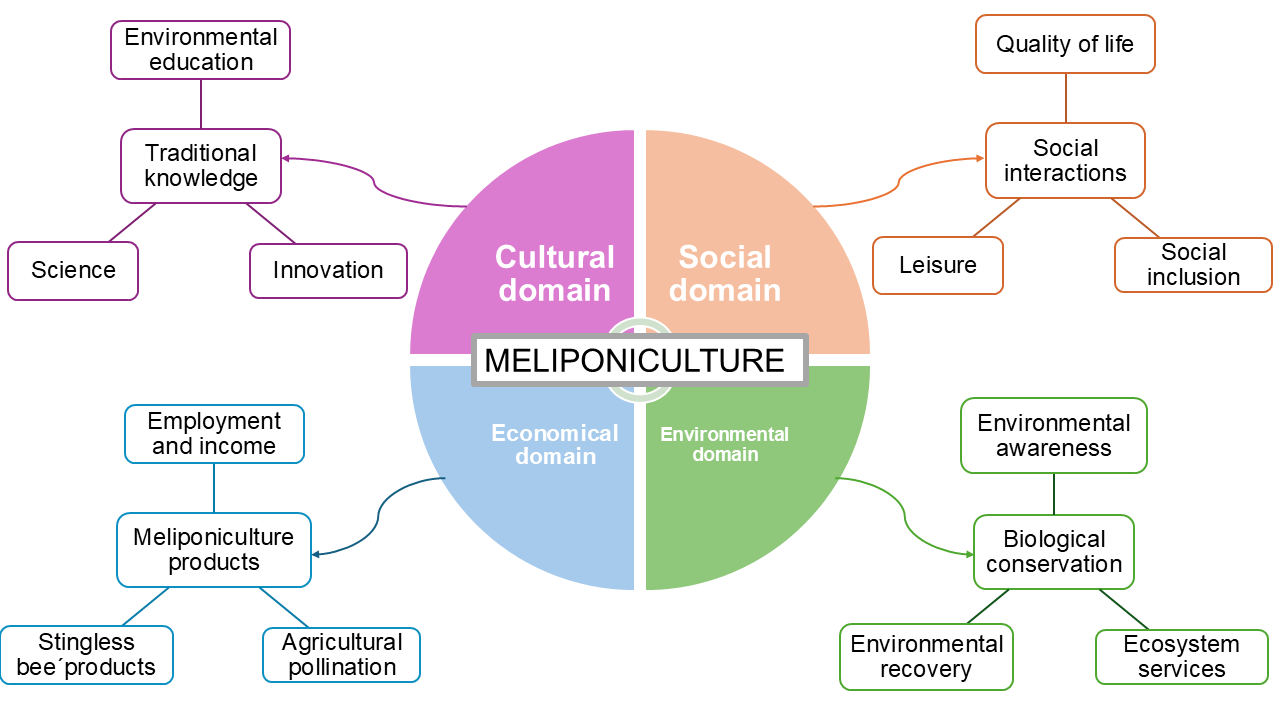
Figure 1. Domains of meliponiculture. (modified from Barbiéri et al., 2020) – Domaines de la méliponiculture (adapté d’après Barbiéri et al., 2020).
6Nowadays, the popularity of meliponiculture in Ecuador is largely due to the COVID-19 pandemic, which negatively affected rural family economies while simultaneously boosting the purchase and use of pot-honey as a medicinal supplement for respiratory complaints. The development of initiatives that use this practice in agroecological systems, along with the renewed appreciation for native bee species over the European honey bee, has further contributed to its expansion (Naturaleza y Cultura Internacional, 2025; World Vision, 2025). This practice has advanced through the design and use of wooden boxes (modern nests) to improve the management of species such as Melipona (Michmelia) rufiventris Lepeletier, 1836 (Richard et al., 2019). In Ecuador, meliponiculture farmers transfer a nest of stingless bees, usually located in hollow trees that have fallen naturally to a modern, technical wooden box to facilitate and improve their management (Ocaña-Cabrera et al., 2024). Meliponiculture is practised in a variety of forms throughout the country including artisanal and subsistence models, as well as commercial, scientific, educational, conservation, and entomotourism models (Aldasoro Maya et al., 2023; Ocaña Cabrera, 2025).
7In several Latin American countries, including Ecuador, the market price of meliponine honey ranges from 40–200 USD (35–173 EUR) per litre (Quezada-Euán, 2018). The value of stingless bee honey is determined by various factors, including the species of origin, the method of production, the regional availability, and the demand. A unique component of the pot-honey of stingless bees is trehalulose, a reducing disaccharide sugar that serves as an indicator of the authenticity and quality of a natural product (Zhang et al., 2022). The bioactive properties of stingless bee honey encompass a range of characteristics, including anti-cataract, anti-inflammatory, antimicrobial, antioxidant, antiproliferative, and neuroprotective effects (Vit et al., 2024).
2.3. Known and emerging threats to stingless bees in Ecuador
8The ornamental use of Spathodea campanulata P. Beauv., 1805, as part of territorial ordinances in different cities in Ecuador, poses a threat to local biodiversity due to the potentially toxic nectar produced by the flower (Queiroz et al., 2014). In the country, 303 stingless bees were found dead inside 140 flowers of this plant (Padrón & Campaña, 2025), thereby contributing to native bee mortality due to the introduction of invasive species into the territory.
9A further threat to the sustainability of this practice in Ecuador is the absence of regulations governing meliponiculture, coupled with the inexperience of new practitioners who join this practice out of economic ambition rather than for the conservation of these native bees (Quezada-Euán et al., 2022). The transfer of stingless bee colonies from one region to another, exhibiting divergent environmental characteristics, has been identified as a significant contributing factor to the invasive propagation of certain species of stingless bees in regions where they are not endemic (dos Santos et al., 2022). This phenomenon, although not yet formally documented in Ecuador, is of particular concern and requires further investigation to understand its full implications and potential impact on ecological balance. The substantial extraction of wild nests, propelled by economic ambition, and the subsequent division or micro-division of colonies to increase the number of nests, yet with a minimal survival rate due to the absence of biological criteria on the part of those engaged in this practice, are significant concerns. At the genetic level, the reduction in diversity leads to inbreeding or a genetic bottleneck that results in an increase in diploid male production (May-Itzá et al., 2021). The ongoing threat of predatory extractivism and habitat destruction has led to the local extinction of Melipona quadrifasciata in north-eastern Brazil (Araújo et al., 2016).
10Pests and pathogens (i.e., Nosema ceranae, Lysinibacillus sphaericus, deformed wing virus, or the acute bee paralysis virus), together with pesticides, especially neonicotinoids, and climate change, further intensify the threats already faced by stingless bees (Ocaña-Cabrera et al., 2025).
3. CONCLUSIONS
11Meliponiculture in Ecuador has emerged as a means of economic support for families in rural areas of tropical regions. Its management and care focus on sustainable use of products such as pot-honey, while conserving its habitat and improving the genetic diversity of mixed crops or agroforestry systems, which families have returned to as an environmentally sustainable alternative.
Bibliographie
Aizen M.A. et al., 2019. Global agricultural productivity is threatened by increasing pollinator dependence without a parallel increase in crop diversification. Global Change Biol., 25(10), 3516-3527, doi.org/10.1111/gcb.14736
Aldasoro Maya E.M. et al., 2023. Stingless bee keeping: biocultural conservation and agroecological education. Front. Sustainable Food Syst., 6, doi.org/10.3389/fsufs.2022.1081400
Araújo E.D. et al., 2016. Risk of local extinction and genetic diversity of Melipona quadrifasciata (Apidae: Meliponini) in a possible Northeastern limit of its distribution in Brazil. Sociobiology, 63(2), 804-812, doi.org/10.13102/sociobiology.v63i2.946
Armas-Quiñonez G. et al., 2020. Bee diversity in secondary forests and coffee plantations in a transition between foothills and highlands in the Guatemalan Pacific Coast. PeerJ, 8, e9257, doi.org/10.7717/peerj.9257
Barbiéri C. & Francoy T.M., 2020. Theoretical model for interdisciplinary analysis of human activities: meliponiculture as an activity that promotes sustainability. Ambient. Soc., 23, e00202, doi.org/10.1590/1809-4422asoc20190020r2vu2020L4AO
Bulle Bueno F., Gloag R., Latty T. & Ronai I., 2020. Irreversible sterility of workers and high-volume egg production by queens in the stingless bee Tetragonula carbonaria. J. Exp. Biol., 223(18), jeb230599.
Bulle Bueno F.G. et al., 2023. Stingless bee floral visitation in the global tropics and subtropics. Global Ecol. Conserv., 43, e02454, doi.org/10.1016/j.gecco.2023.e02454
Campbell A.J. et al., 2019. Pollinator restoration in Brazilian ecosystems relies on a small but phylogenetically-diverse set of plant families. Sci. Rep., 9(1), 17383, doi.org/10.1038/s41598-019-53829-4
Costa R.A.C. & Cruz-Landim C., 1999. Occurrence and morphometry of the hypopharyngeal glands in Scaptotrigona postica Lat. (Hymenoptera, Apidae, Meliponinae). J. Biosci., 24(1), 97-102, doi.org/10.1007/BF02941113
da Costa Macedo C.R. et al., 2021. Nesting behavior of stingless bees. Ciênc. Anim. Bras., 21, e-58736, doi.org/10.1590/1809-6891v21e-58736
de Portugal Araujo V., 1963. Subterranean nests of two African stingless bees (Hymenoptera: Apidae). J. N. Y. Entomol. Soc., 71(3), 130-141.
dos Santos C.F. et al., 2022. The widespread trade in stingless beehives may introduce them into novel places and could threaten species. J. Appl. Ecol., 59(4), 965-981, doi.org/10.1111/1365-2664.14108
Engel M.S., Rasmussen C., Ayala R. & de Oliveira F.F., 2023. Stingless bee classification and biology (Hymenoptera, Apidae): a review, with an updated key to genera and subgenera. ZooKeys, 1172, 239-312, doi.org/10.3897/zookeys.1172.104944
Erazo A.G.C., Tapia M.F.B., Rivera S.A.G. & Moposita D.A.M., 2023. La meliponicultura: una alternativa de conservación y aprovechamiento sostenible de abejas nativas en la Amazonía ecuatoriana. Tesla Rev. Científica, 3(1), e157-e157, doi.org/10.55204/trc.v3i1.e157
Giannini T.C. et al., 2015. Crop pollinators in Brazil: a review of reported interactions. Apidologie, 46(2), 209-223, doi.org/10.1007/s13592-014-0316-z
Gilliam M., Buchmann S.L., Lorenz B.J. & Roubik D.W., 1985. Microbiology of the larval provisions of the stingless bee, Trigona hypogea, an obligate necrophage. Biotropica, 17(1), 28-31, doi.org/10.2307/2388374
Grüter C., 2020. Nesting biology. In: Grüter C., ed. Stingless bees: their behaviour, ecology and evolution, fascinating life sciences. Cham, Switzerland: Springer International Publishing, 87-130.
Grüter C., von Zuben L.G., Segers F.H.I.D. & Cunningham J.P., 2016. Warfare in stingless bees. Insectes Sociaux, 63(2), 223-236, doi.org/10.1007/s00040-016-0468-0
Grüter C., Balbuena M.S. & Valadares L., 2023. Mechanisms and adaptations that shape division of labour in stingless bees. Curr. Opin. Insect Sci., 58, 101057, doi.org/10.1016/j.cois.2023.101057
Jha S. & Dick C.W., 2010. Native bees mediate long-distance pollen dispersal in a shade coffee landscape mosaic. PNAS, 107(31), 13760-13764, doi.org/10.1073/pnas.1002490107
May-Itzá W. et al., 2021. Stingless bees in urban areas: low body size and high frequency of diploid males at mating congregations of Nannotrigona perilampoides (Hymenoptera: Meliponini) in Mérida, Yucatán, México. Apidologie, 52(4), 755-766, doi.org/10.1007/s13592-021-00862-w
Melo G.A.R., 2020. Stingless bees (Meliponini). In: Starr C.K., ed. Encyclopedia of social insects. Cham, Switzerland: Springer International Publishing, 1-18.
Mera-Shiguango A.P., Castro-Delgado C.J. & Vega-Játiva M., 2022. The role of ancestral knowledge in the development of agriculture in the south-central microregion of Manabí, Ecuador. Int. J. Soc. Sci. Humanit., 6(3), 220-232, doi.org/10.53730/ijssh.v6n3.13706
Michener C.D., 2007. The bees of the world. Baltimore, MD, USA : Johns Hopkins University Press, 953.
Naturaleza y Cultura Internacional, 2025. Miel por bosque: abejas sin aguijón y meliponicultura en Puyango. Protecting threatened forests in Latin America. Del Mar, CA, USA: Naturaleza y Cultura Internacional.
Ocaña-Cabrera J.S., 2025. Factors affecting the health and sustainability of stingless bees (Hymenoptera, Meliponini) colonies in Ecuador: interactions between management practices, pesticide exposure, floral resources, and pathogens. PhD thesis : Université de Liège (Belgium).
Ocaña-Cabrera J.S., Martin-Solano S. & Saegerman C., 2024. Development of tools to understand the relationship between good management practices and nest losses in meliponiculture: a pilot study in Latin American countries. Insects, 15(9), 715, doi.org/10.3390/insects15090715
Ocaña-Cabrera J.S., Ron-Román J., Martin-Solano S. & Saegerman C., 2025. Chemical contaminants in cerumen samples from Ecuadorian stingless bees: reporting glyphosate, aminomethylphosphonic acid, and the presence of metals and metalloids. Insects, 16(11), doi.org/10.3390/insects16111079
Padrón P.S. & Campaña M., 2025. Registro de mortalidad de abejas nativas asociada a flores de Spathodea campanulata P. Beauv, 1805 en Ecuador. Ecuador es calidad, 10(2), 13-13, doi.org/10.36331/revista.v10i2.263
Paredes Bracho A.J., 2022. Riqueza de especies de abejas nativas amazónicas sin aguijón de los géneros Melipona y Tetragonisca (Hymenoptera: Apidae: Meliponini) y usos de su miel según los pobladores de la comunidad etno-ecológica Pablo López de Oglán Alto, cantón Arajuno – provincia de Pastaza – Ecuador. Bachelor’s thesis : Universidad Central del Ecuador, Quito (Ecuador).
Potapov P. et al., 2022. Global maps of cropland extent and change show accelerated cropland expansion in the twenty-first century. Nat. Food, 3(1), 19-28, doi.org/10.1038/s43016-021-00429-z
Queiroz A.C.M., Contrera F.A.L. & Venturieri G.C., 2014. The effect of toxic nectar and pollen from Spathodea campanulata on the worker survival of Melipona fasciculata Smith and Melipona seminigra Friese, two Amazonian stingless bees (Hymenoptera: Apidae: Meliponini). Sociobiology, 61(4), 536-540, doi.org/10.13102/sociobiology.v61i4.536-540
Quezada-Euán J.J.G., 2018. Stingless bees of Mexico: the biology, management and conservation of an ancient heritage. Cham, Switzerland: Springer International Publishing.
Quezada-Euán J.J.G., May-Itzá W.J., de la Rúa P. & Roubik D.W., 2022. From neglect to stardom: how the rising popularity of stingless bees threatens diversity and meliponiculture in Mexico. Apidologie, 53(6), article 70, doi.org/10.1007/s13592-022-00975-w
Ramalho M., 2004. Stingless bees and mass flowering trees in the canopy of Atlantic Forest: a tight relationship. Acta Bot. Bras., 18, 37-47, doi.org/10.1590/S0102-33062004000100005
Ribeiro M. de F. & Bego L.R., 1994. Absconding in the Brazilian stingless bee Frieseomelitta silvestrii languida Moure (Hymenoptera: Apidae: Meliponinae). Anais Soc. Entomol. Bras., 23(2), 355-358, doi.org/10.37486/0301-8059.v23i2.953
Richard E., Cevallos H., Chávez P. & Contreras Zapata D., 2019. Diseño de una caja estandarizada para la especie Melipona rufiventris como alternativa socioeconómica sostenible para el área rural de Manabí, Ecuador. In: Memorias VIII Evento internacional La Universidad en el siglo XXI, 20-22 Noviembre 2019, Campus Politécnico, sitio El Limón, Calceta, Manabí, Ecuador. Manabí, Ecuador: Escuela Superior Politécnica Agropecuaria de Manabí Manuel Félix López, 1-24.
Roubik D.W., 2018. 100 species of meliponines (Apidae: Meliponini) in a parcel of Western Amazonian forest at Yasuní Biosphere Reserve, Ecuador. In: Vit P., Pedro S.R.M. & Roubik D.W., eds. Pot-pollen in stingless bee melittology. Cham, Switzerland: Springer International Publishing, 189-206.
Shackleton K. et al., 2015. Appetite for self-destruction: suicidal biting as a nest defense strategy in Trigona stingless bees. Behav. Ecol. Sociobiol., 69(2), 273-281, doi.org/10.1007/s00265-014-1840-6
Sommeijer M.J., Chinh T.X. & Meeuwsen F.J.A.J., 1999. Behavioural data on the production of males by workers in the stingless bee Melipona favosa (Apidae, Meliponinae). Insectes Sociaux, 46(1), 92-93, doi.org/10.1007/s000400050118
Villagómez G.N. et al., 2024a. Nutrients or resin? The relationship between resin and food foraging in stingless bees. Ecol. Evol., 14(2), e10879, doi.org/10.1002/ece3.10879
Villagómez G.N., Spaethe J. & Leonhardt S.D., 2024b. The stingless bee Trigona fulviventris prefers sweet and salty over savory nectar. Apidologie, 55(4), article 39, doi.org/10.1007/s13592-024-01081-9
Vit P. et al., 2024. Stingless bee honey: nutraceutical properties and urgent call for proposed global standards. Trends Food Sci., 157, article 104844, doi.org/10.1016/j.tifs.2024.104844
Vollet-Neto A. et al., 2017. Diploid male production results in queen death in the stingless bee Scaptotrigona depilis. J. Chem. Ecol., 43(4), 403-410, doi.org/10.1007/s10886-017-0839-7
Vollet-Neto A. et al., 2018. Recent advances in reproductive biology of stingless bees. Insectes Sociaux, 65(2), 201-212, doi.org/10.1007/s00040-018-0607-x
von Zuben L.G. et al., 2016. Interspecific chemical communication in raids of the robber bee Lestrimelitta limao. Insectes Sociaux, 63(2), 339-347, doi.org/10.1007/s00040-016-0474-2
World Vision, 2025. Meliponicultura en la Amazonía: un modelo para combatir la pobreza y preservar el bosque, https://www.infobae.com/inhouse/2025/09/30/meliponicultura-en-la-amazonia-un-modelo-para-combatir-la-pobreza-y-preservar-el-bosque/
Zhang J. et al., 2022. How is trehalulose formed by Australian stingless bees? An intermolecular displacement of nectar sucrose. J. Agric. Food Chem., 70(21), 6530-6539, doi.org/10.1021/acs.jafc.2c01732
